



Part two of two. Part one examines what is breaking in traditional fund administration and the trade-offs most managers underestimate. [Read part one here]
In part one, we looked at why traditional fund administration is breaking and what the hidden costs of staying with a legacy model look like in practice. In this piece, we move from the problem to the point of view: what an AI-native operating system actually means, who it is built for, and why the regulatory complexity of European private markets is not a burden to manage but an advantage to own.
The gap is widening, and complexity is becoming a competitive moat
The gap between traditional fund administration and an AI-native operating system continues to grow. Research from the World Economic Forum shows that 80% of private equity workflows already rely heavily on technology for deal sourcing, due diligence and portfolio management, with 95% of firms planning to multiply AI investments over the next 18 months. (Source: World Economic Forum, The Future of Capital Markets, 2024)
However, adoption in back-office operations lags behind. While firms invest in front-office technology, many still rely on traditional administration models that create the data fragmentation and manual processes that newer systems are designed to eliminate.
This imbalance is becoming harder to sustain. As investment teams accelerate, operational infrastructure determines whether reporting keeps pace or becomes a constraint. Beyond NAV: Why Fund Administration Has Become a Capital Raising Strategy examines how this imbalance is reshaping LP expectations.
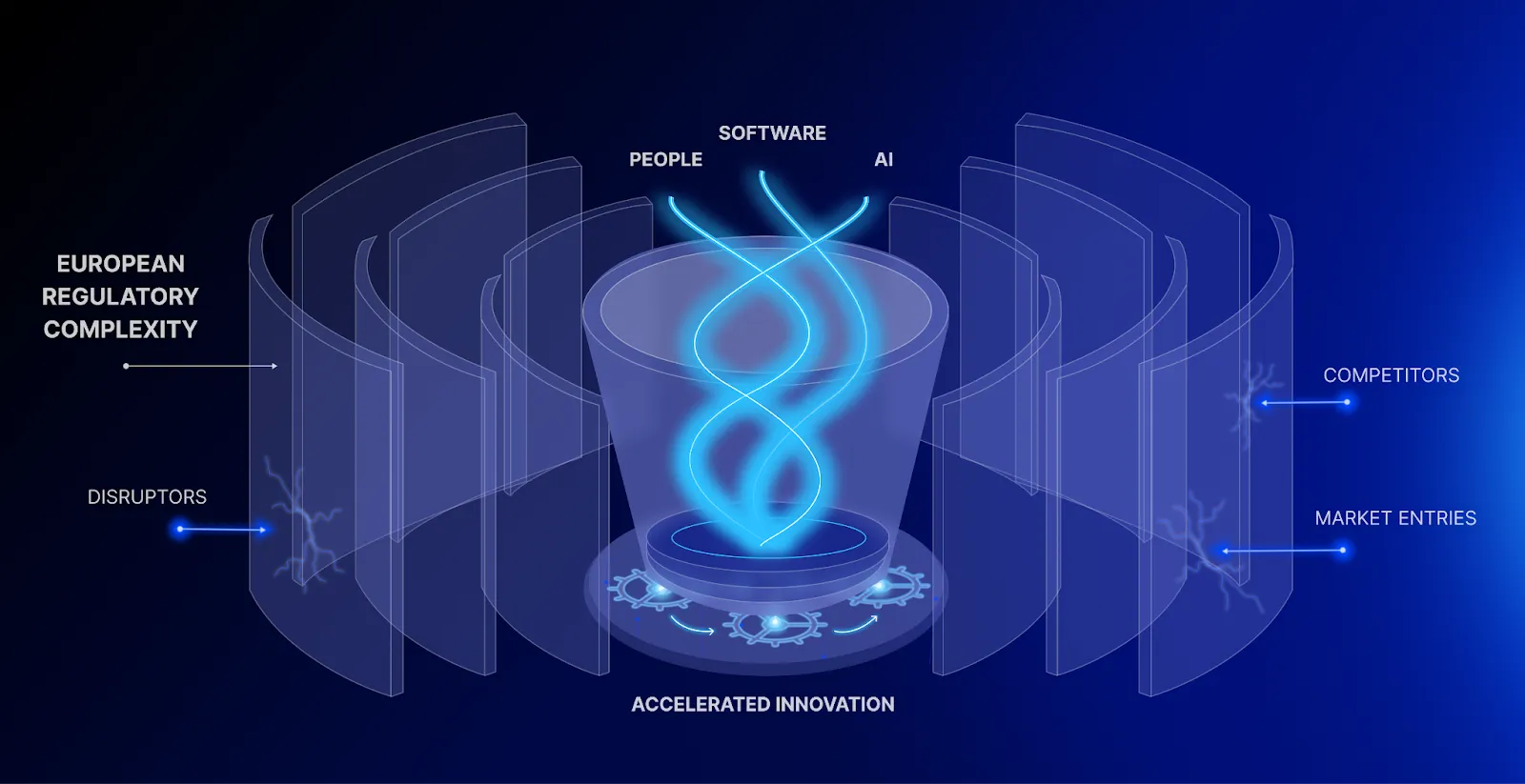
In Europe, this challenge is amplified by regulatory complexity. There is no single European standard. Germany, the UK, Luxembourg and the Netherlands each carry distinct requirements around fund structuring, investor reporting obligations, tax treatment and regulatory filings. For managers operating across borders, the operational burden is not just significant. It is a genuine barrier to entry. Legacy providers, built for single-jurisdiction service delivery, struggle to absorb this complexity at scale. The fragmentation compounds.
For a new generation of AI-first operators, however, that same complexity becomes a source of durable advantage. By encoding jurisdiction-specific logic at the calculation and workflow level, not layering it on top as an afterthought, it becomes increasingly difficult for others to replicate. Every edge case solved deepens the moat.
That infrastructure gap carries a measurable cost. McKinsey research shows that effective deployment of technology and AI could generate an ROI of more than tenfold across investment returns, operational efficiency and risk management.
Who an AI-native operating system is best for
An AI-native operating system suits emerging managers who want an institutional operating model from day one and do not want operations to become a constraint on growth. It also fits established funds where investor expectations have outpaced the way the back office currently runs. The biggest concern with migration is losing historical context. bunch addresses this directly: its LLM ingests the accumulated history of LP files, PDFs, emails and legacy reports, extracting the right data automatically. A member of the bunch team then reviews and confirms every input before it goes live in the system. Nothing is lost and nothing is assumed. Migration mid-cycle is also more viable than most managers expect. With legacy providers, moving is risky because knowledge lives in individuals. With bunch, onboarding is system-led. The transition does not depend on key-person handovers or institutional memory walking out the door. The system holds the context. The fund keeps moving.
For teams that need faster reporting without increasing operational workload, it reduces the day-to-day effort required to meet investor demands. For UK-based emerging managers specifically, Fund Launch 101: How to Navigate the Process with a Host AIFM in the UK is a useful companion read.
Emerging managers often feel the strain between Fund I and Fund II. What worked with a small team does not hold up as the pace increases and more stakeholders expect timely, accurate information. The question is whether your current setup will support your next fund, or whether you will need to rebuild it mid-cycle. bunch's Emerging Fund Manager report covers this transition in depth, with exclusive interviews from managers who have navigated it.
How to evaluate whether a provider is truly AI-native
A genuine AI-native operating system should stand up to these questions:
- Can you see your data and workflows, not just receive outputs?
- Is there a clear source of truth?
- Are templates and processes repeatable quarter to quarter?
- Can you track changes, approvals and ownership?
- Can the model support scale across funds, vehicles and investor requirements?
Technology should enhance control, not simply process transactions. You should be able to initiate capital calls, distributions and fundraises directly in the system, track progress in real time and rely on audit trails by default. Without that level of visibility, teams replicate work internally and absorb the very operational drag the model claims to remove.
Why complexity is our competitive advantage at bunch
Neither model alone is enough. Service-only administration is increasingly displaced: it is slow, patchwork and unreliable at scale. Platform-only is increasingly challenged: software without deep regulatory expertise and institutional service cannot absorb the operational complexity that modern funds face. Both are old-world models and both are breaking.
What the market needs is not a better version of either. It needs a three-fold model built for fund intelligence: the right people, the right software, and AI that is actually reliable. Each reinforces the other. At bunch, we call this combination AI-native data infrastructure, platform, and expert-in-the-loop.
The AI piece deserves particular attention. Everyone is talking about AI transforming fund operations, but almost no one is asking which data actually matters. AI alone does not fix messy data. It amplifies it. The real opportunity lies in building clean data foundations that make AI reliable, not just impressive. bunch has been doing exactly that in Europe, reducing data entropy and compounding clean infrastructure over time. That accumulated foundation is the deepest part of our moat. It cannot be replicated by a new market entrant overnight. It took years of regulatory depth, local client relationships and jurisdiction-specific logic encoded at the calculation level to build. The Data Silo Is Not a Tech Problem — It's a Structural One explains why clean data foundations are the prerequisite for everything else.
At the core is our System of Record, an AI-accessible operating backbone in which every fund on the platform is stored, structured and queryable. Context carries forward from one reporting cycle to the next. Reporting no longer needs to be rebuilt each quarter. Reviews and approvals happen within the workflow itself. Investor requests remain connected to live data rather than static documents. Institutional knowledge lives in the system, not in inbox history.
This is why complexity is not a burden for bunch. It is the engine. The GP who understands this is not simply choosing a fund administrator. They are choosing an ownership model: an intelligent execution layer that informs decisions proactively rather than explaining what happened last quarter.
bunch is built for scale from day one. As funds launch new vehicles, onboard new investors or prepare for the next raise, the operating model strengthens rather than stretches.
"bunch has significantly simplified our operations and elevated our processes to a new level. Their reliable all-in-one solution has streamlined workflows and improved efficiency across the board." — Julian Kappus, Founding Partner at Heliad
Modern fund administration should be scalable
Fund administration is moving from service delivery to system-led operations, raising the standard for reporting and data management. As complexity increases, service-led models begin to strain while integrated operating models grow stronger. The old models, pure SaaS that leaves managers to do the work, or pure service trapped in manual processes, are being displaced. The shift is towards infrastructure: people, software and AI working together as a single compounding system.
The real question is whether your administrator strengthens as your fund evolves. bunch is built for that shift, delivering institutional-grade fund administration on a digital operating backbone designed to scale. Read how leading funds are already experiencing this in our Case Studies. See how that model works in practice, get in touch.
The best already build on bunch






















.webp)
