



Part one of two. Part two explores how an AI-native operating system addresses these challenges and why complexity in European private markets is an advantage, not a burden. [Read part 2 here]
The choice of fund administrator is one of the most strategically impactful choices a scaling fund manager makes. What was once a back-office service delivering NAVs and reports has become the operational backbone for capital activity, investor communication and regulatory data. As investor expectations accelerate and compliance requirements grow, this layer increasingly determines how resilient and scalable a fund can become.
Large funds still default to traditional providers because the market, until recently, had yet to offer a structurally superior alternative. In Europe, fund administration developed as an outsourced service model built to manage AIFM obligations, depositary relationships and cross-border fund structures. These arrangements often span multiple jurisdictions and carry detailed institutional LP reporting requirements. But the modern day investor expects fast answers and real-time visibility, marking the end of fragmented operations.
In this article, we look at what is breaking in traditional fund administration, the trade-offs most managers underestimate, and the hidden costs of staying with a model that was not built for where private markets are heading.
Traditional fund administration works, until operations start slowing you down
Traditional fund administration has long supported institutional managers effectively, with many leading funds continuing to operate successfully with legacy administrators today. The existing model, however, optimises for service delivery rather than system design, with coordination relying on human communication and handoffs over integrated structures. As funds evolve, reporting, treasury and cash-flow processes become harder to manage across jurisdictions. With rising investor expectations, this ongoing coordination becomes harder to sustain.
The impact is felt most clearly in investor reporting, where faster access to performance and valuation data is now standard. 74% of investors expect instant access to NAV fund data and operational metrics, and there is a growing "no-PDF" mindset across the LP base (source). Without a structured digital platform, meeting those expectations is virtually impossible. Manual processes drive up human operational costs and stall execution, as constant coordination replaces scalable structure.
The trade-offs fund managers underestimate
With traditional administration, the trade-offs are speed and predictability. Work moves through manual coordination rather than structured workflows. Handovers, version control and reconciliation slow execution. The result is inconsistent outputs and follow-up requests that should not be necessary.
This mirrors what McKinsey observes across institutional investors: many still rely on spreadsheets and emails for tasks that could be automated, with only 18% reporting that front-office teams can access data without manual intervention.
Those trade-offs surface when growth accelerates. Teams compensate for operational gaps that the model cannot absorb. See how funds are addressing this operationally in how to cut 20 hours from Quarterly Reporting.
Would your administrator strengthen your next fundraise or slow it down? If you launched two new vehicles this year, would your operations scale or would you need to hire?
The answers reveal whether complexity is handled by structure or by coordination.
Traditional fund administration vs an AI-native operating system
Traditional fund administration and AI-native operating systems run on fundamentally different operating models. One relies on coordination between people to move work forward. The other embeds workflows and data into structured systems that carry context across cycles, decoupling operational output from headcount growth. For a broader view of what is driving this shift, read The BPO model is breaking: How AI is rewriting fund administration in private markets.
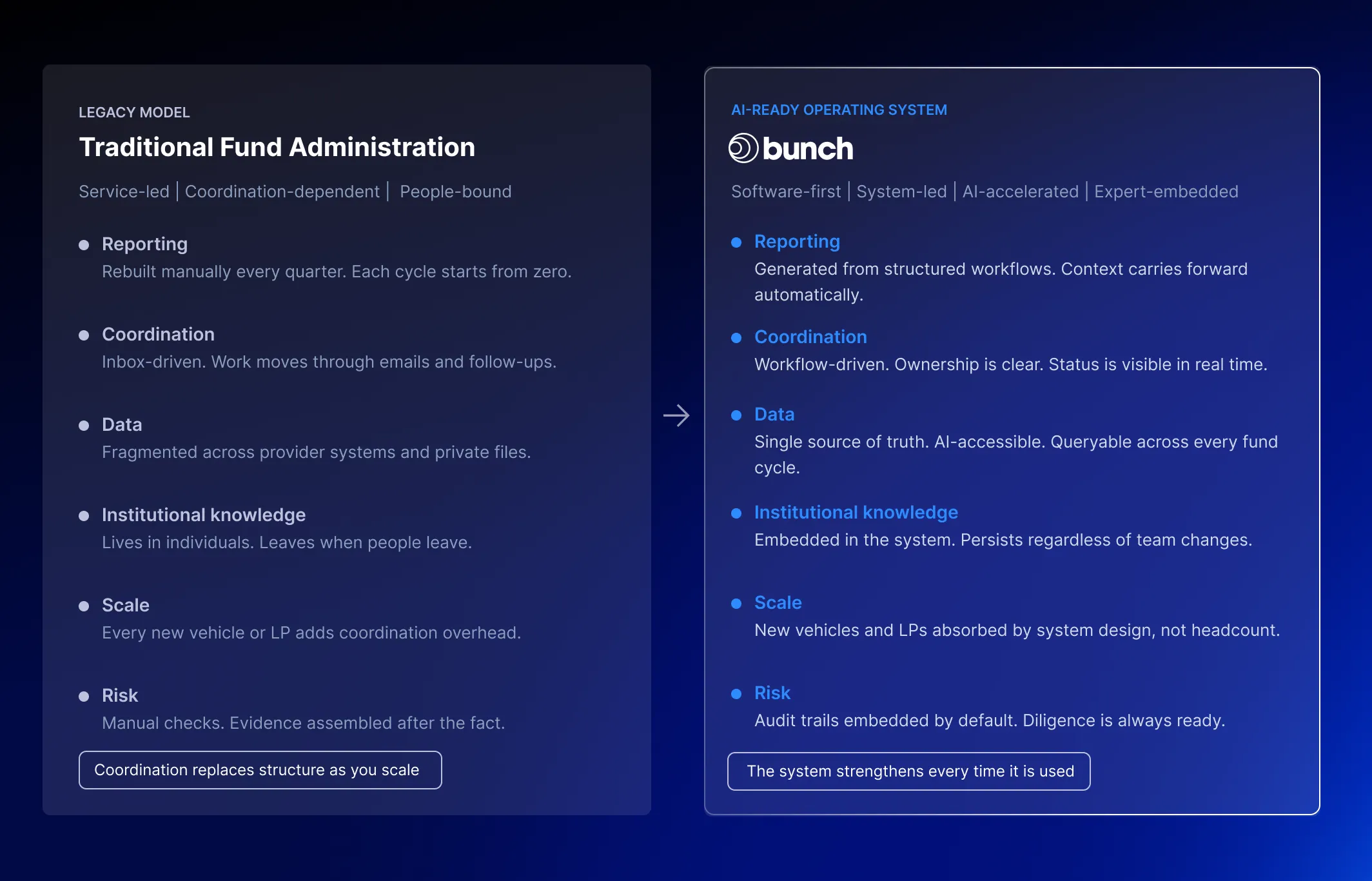
The five moments where the two models feel completely different
The contrast between traditional fund administration and an AI-native operating system shows up most clearly in how everyday fund operations run.
- Data ownership and visibility: In traditional administration, data sits across provider systems and private files. Teams rely on requests and follow-ups to understand what is current. Visibility depends on people.With an AI-native operating system, teams work from a single source of truth, so answers are easier to find and less dependent on individuals. Institutional knowledge lives in the system, not in email threads.
- Reporting speed and consistency: Traditional reporting is rebuilt and reconciled each quarter, creating pressure and rework every cycle.An AI-native operating system generates reporting from structured workflows, improving consistency and reducing last-minute fixes and investor follow-ups. The goal is not just faster reporting. It is reporting that does not need to be rebuilt from scratch each time.
- Scaling across vehicles, investors, and complexity: With traditional providers, added complexity increases coordination and headcount. Growth increases operational drag. An AI-native operating system handles complexity through structure and automation, allowing funds to scale without operations becoming a constraint. This is what it means to decouple AUM growth from operational headcount.
- Collaboration between your team and your administrator: Traditional administration runs on input and output. Work moves behind the scenes. Status requires checking. An AI-native operating system uses shared workflows, which clarifies ownership and reduces back-and-forth around timelines and status.
- Risk, security, and defensibility: Traditional processes rely on manual checks and institutional memory. Evidence is assembled when questions arise.
An AI-native operating system embeds controls and audit trails into the system by default, making diligence easier and operational risk easier to manage. In an environment where institutional LPs conduct detailed operational due diligence alongside investment evaluation, that auditability is not a nice-to-have. It is a fundraising requirement.
Why funds still choose legacy providers
Funds often choose legacy providers for rational reasons. In an industry built on trust, familiar models feel like a form of risk mitigation. A recognised provider signals credibility during diligence and fundraising. That signal often carries more weight than a close examination of how the operating model actually runs.
Familiarity and brand recognition. Service providers are reviewed during diligence, and a recognised name streamlines the process. Because reporting standards, fee structures and compliance frameworks are already familiar, managers spend less time explaining their setup.
Perceived operational maturity. Longevity signals resilience. Providers that have survived multiple cycles are seen as stable and well resourced. Investors assume the platform will continue running regardless of individual turnover.
"No one gets fired for buying IBM" logic. The old business adage still applies. Choosing the industry standard protects the decision-maker when problems surface. If a large legacy provider makes an error, it is often treated as an unavoidable event. That perception provides professional cover.
These reference points have shaped fund administration for decades. But brand recognition and longevity do not automatically translate into operational transparency. As expectations rise, it makes sense to evaluate how the system actually runs, not just who stands behind it. Beyond NAV: Why Fund Administration Has Become a Capital Raising Strategy explores why this evaluation is becoming a strategic decision, not just an operational one.
The hidden cost of choosing "good enough" administration
Choosing traditional administration based on stability and familiarity can feel rational. But "good enough" becomes expensive under investor pressure. Reporting cycles stretch and manual workload increases for operations and finance. Transparency for investors declines. Over time, knowledge accumulates in individuals and inbox history, which makes transitions harder when you decide to modernise.
The cost often appears in duplicated effort. Research from SEI shows that 55% of firms maintain an internal accounting book of record despite outsourcing to a fund administrator. This replication consumes 43% of non-investment staff time and delays reporting by three or more days at nearly half of firms surveyed. The result is operational drag that compounds over time.
The model needs to change. The question is which model comes next.
The question is not whether traditional fund administration is under pressure. The data makes that clear. The question is which model is actually built for what comes next – for the regulatory complexity of European private markets, for institutional LP expectations that continue to rise, and for the operational demands of funds that are scaling faster than their infrastructure was designed to support.
That is where bunch comes in. Built at the intersection of expert fund administration and AI-native software, bunch is designed to turn operational complexity from a constraint into a compounding advantage.
In part two, we look at how an AI-native operating system addresses these challenges directly, why complexity in European private markets is an advantage rather than a burden, and what the three-fold model of people, software and AI means in practice.
The best already build on bunch






















.webp)
